Showing posts with label Copper. Show all posts

Wednesday, October 15, 2025

Gold Production Mirrors the Long Wave, It Doesn’t Drive It | Nikolai Kondratieff

As regards the opening-up of new countries for the world economy, it seems to be quite obvious that this cannot be considered an outside factor which will satisfactorily explain the origin of long waves. The United States have been known for a relatively very long time; for some reason or other they begin to be entangled in the world economy on a major scale only from the middle of the nineteenth century. Likewise, the Argentine and Canada, Australia and New Zealand, were discovered long before the end of the nineteenth century, although they begin to be entwined in the world economy to a significant extent only with the coming of the 1890’s. 
 
Second Transvaal Gold Rush: Miners of the Republic Gold Mining Company, De Kaap Valley, Eastern Transvaal gold fields, South Africa, 1888.
» We know that commodity prices reach their lowest level toward the end of a long wave. This means
that at this time gold has its highest purchasing power, and gold production becomes most favorable. «
Second Transvaal Gold Rush: Miners of the Republic Gold Mining Company,
De Kaap Valley, Eastern Transvaal gold fields, South Africa, 1888.
 
It is perfectly clear historically that, in the capitalistic economic system, new regions are opened for commerce during those periods in which the desire of old countries for new markets and new sources of raw materials becomes more urgent than theretofore. It is equally apparent that the limits of this expansion of the world economy are determined by the degree of this urgency. If this be true, then the opening of new countries does not provoke the upswing of a long wave. On the contrary, a new upswing makes the exploitation of new countries, new markets, and new sources of raw materials necessary and possible, in that it accelerates the pace of capitalistic economic development.

There remains the question whether the discovery of new gold mines, the increase in gold production, and a consequent increase in the gold stock can be regarded as a casual, outside factor causing the long waves. An increase in gold production leads ultimately to a rise in prices and to a quickening in the tempo of economic life. But this does not mean that the changes in gold production are of a casual, outside character and that the waves in prices and in economic life are likewise caused by chance. We consider this to be not only unproved but positively wrong. 
 
California Gold Rush (1848–1855): Over 300,000 settlers flooded newly conquered Mexican territory, seizing lands of 70 indigenous peoples and carrying out California Genocide.
 » An increase in gold production leads ultimately to a rise in prices. «
California Gold Rush (1848–1855): Over 300,000 settlers flooded newly conquered Mexican
territory, seizing lands of 70 indigenous peoples and carrying out the California Genocide.
 
This contention originates from the belief, first, that the discovery of gold mines and the perfection of the technique of gold production are accidental and, secondly, that every discovery of new gold mines and of technical inventions in the sphere of gold production brings about an increase in the latter. However great may be the creative element in these technical inventions and the significance of chance in these discoveries, yet they are not entirely accidental. Still less accidental—and this is the main point—are the fluctuations in gold production itself. 
 
These fluctuations are by no means simply a function of the activity of inventors and of the discoveries of new gold mines. On the contrary, the intensity of inventors’ and explorers’ activity and the application of technical improvement in the sphere of gold production, as well as the resulting increase of the latter, depend upon other, more general causes. The dependence of gold production upon technical inventions and discoveries of new gold mines is only secondary and derived.

Grasberg Mine, operated by PT Freeport Indonesia, is one of the largest global gold and copper reserves, producing 1.7M oz gold, 6M oz silver, and 1.5B lbs copper in 2023.
» 
Although gold is a generally recognized embodiment of value, it is only a commodity. «
Grasberg Mine, operated by PT Freeport Indonesia, is one of the largest global gold
and copper reserves, producing 1.7M oz gold, 6M oz silver, and 1.5B lbs copper in 2023.
 
Although gold is a generally recognized embodiment of value and, therefore, is generally desired, it is only a commodity. And like every commodity it has a cost of production. But if this be true, then gold production—even in newly discovered mines—can increase significantly only if it becomes more profitable, i.e., if the relation of the value of the gold itself to its cost of production (and this is ultimately the prices of other commodities) becomes more favorable. If this relation is unfavorable, even gold mines the richness of which is by no means yet exhausted may be shut down; if it is favorable, on the other hand, even relatively poor mines will be exploited.

When is the relation of the value of gold to that of other commodities most favorable for gold production? We know that commodity prices reach their lowest level toward the end of a long wave. This means that at this time gold has its highest purchasing power, and gold production becomes most favorable. This can be illustrated by the figures in Table 2.

Table 2.— Selected Statistics of Gold Mining in the Transvaal, 1890–1913.


Gold production, as can be seen from these figures, becomes more profitable as we approach a low point in the price level and a high point in the purchasing power of gold (1895 and the following years). It is clear, furthermore, that the stimulus to increased gold production necessarily becomes stronger the further a long wave declines. We, therefore, can suppose theoretically that gold production must in general increase most markedly when the wave falls most sharply, and vice versa.

Wangu Gold Deposit, 2024: China discovered one of the world’s largest gold deposit in Hunan, with over 1,000 tons valued at $83B, located 19 kilometers underground.
» Gold production must in general increase most markedly when the wave falls most sharply, and vice versa. «
Wangu Gold Deposit, 2024: China discovered one of the world’s largest gold deposit
in Hunan, with over 1,000 tons valued at $83B, located 19 kilometers underground.
 
In reality, however, the connection is not as simple as this but becomes more complicated, mainly just because of the effect of the changes in the technique of gold production and the discovery of new mines. It seems to us, indeed, that even improvements in technique and new gold discoveries obey the same fundamental law as does gold production itself, with more or less regularity in timing. Improvements in the technique of gold production and the discovery of new gold mines actually do bring about a lowering in the cost of production of gold; they influence the relation of these costs to the value of gold, and consequently the extent of gold production. 
 
Kumtor Gold Mine, Kyrgyzstan, 2025: Nationalized in 2021, Kumtor, one of Central Asia’s largest gold reserves,  begins underground mining, projected to add 147 metric tons of gold to state reserves over 17 years.
» Improvements in the technique of gold production actually do bring about a lowering in the cost of production of gold. «
Kumtor Gold Mine, Kyrgyzstan, 2025: Nationalized in 2021, one of Central Asia’s largest gold reserves, 
began underground mining, projected to add 147 metric tons of gold to state reserves over 17 years.
 
But then it is obvious that exactly at the time when the relation of the value of gold to its cost becomes more unfavorable than theretofore, the need for technical improvements in gold mining and for the discovery of new mines necessarily becomes more urgent and thus stimulates research in this field. 
 
Muruntau Gold Mine, Uzbekistan, 2025: Holds the world’s largest gold reserves, one of the largest open-pit gold mines, ranks second in global production, producing 2M+ oz annually, expected to operate for decades.
» Gold production is subordinate to the rhythm of the long waves. «
Muruntau Gold Mine, Uzbekistan, 2025: Holds the world’s largest gold reserves, one of the largest open-pit
gold mines, ranks second in global production, producing 2M+ oz annually, expected to operate for decades.
 
There is, of course, a time-lag, until this urgent necessity, though already recognized, leads to positive success. In reality, therefore, gold discoveries and technical improvements in gold mining will reach their peak only when the long wave has already passed its peak, i.e., perhaps in the middle of the downswing. The available facts confirm this supposition. In the period after the 1870’s, the following gold discoveries were made: 1881 in Alaska, 1884 in the Transvaal, 1887 in West Australia, 1890 in Colorado, 1894 in Mexico, 1896 in the Klondike. The inventions in the field of gold-mining technique, and especially the most important ones of this period (the inventions for the treatment of ore), were also made during the 1880’s, as is well known.

Lafigue Gold Mine, Ivory Coast, began production in August 2024,  targeting 200,000 oz gold annually ($800 million) over 13+ years.
» The increase in gold production takes place somewhat earlier than at the end of the downswing of the long wave. «
Lafigue Gold Mine, Ivory Coast, began production in August 2024, targeting 200,000 oz gold annually over 13+ years.
  
Gold discoveries and technical improvements, if they occur, will naturally influence gold production. They can have the effect that the increase in gold production takes place somewhat earlier than at the end of the downswing of the long wave. They also can assist the expansion of gold production, once that limit is reached. This is precisely what happens in reality. Especially after the decline in the 1870’s, a persistent, though admittedly slender, increase in gold production begins about the year 1883, whereas, in spite of the disturbing influences of discoveries and inventions, the upswing really begins only after gold has reached its greatest purchasing power; and the increased production is due not only to the newly discovered gold fields but in a considerable degree also to the old ones. This is illustrated by the figures in Table 3.

Table 3.— Gold Production, 1890–1900 (Unit: thousand ounces).

From the foregoing one may conclude, it seems to us, that gold production, even though its increase can be a condition for an advance in commodity prices and for a general upswing in economic activity, is yet subordinate to the rhythm of the long waves and consequently cannot be regarded as a causal and random factor that brings about these movements from the outside.


See also: 
 
 » Since the Kondratieff wave was not a transverse wave, meaning the wavelength varied, this tends to imply we may see the “real” high in commodity prices (adjusted for inflation) form in line with the ECM in 2032. This is by no means a straight, linear progression. There will be booms and busts along the way. Therefore, that is when we will see the final REAL high in gold, agriculturals, metals, etc. «   Martin Armstrong, March 16, 2013.

Thursday, March 7, 2024

S&P 500 vs Copper | J.C. Parets

The relationship between the copper price and the S&P 500 Index is one of generally positive correlation, with divergent movements at times. The copper price is an economic bellwether due to its extensive industrial usage; the S&P represents general equity market sentiment. In the days of inflation driven AI craze the price of copper keeps declining.

Friday, October 21, 2022

Global Real Estate Bubble Index 2022 | 18.6 Year Real Estate Cycle

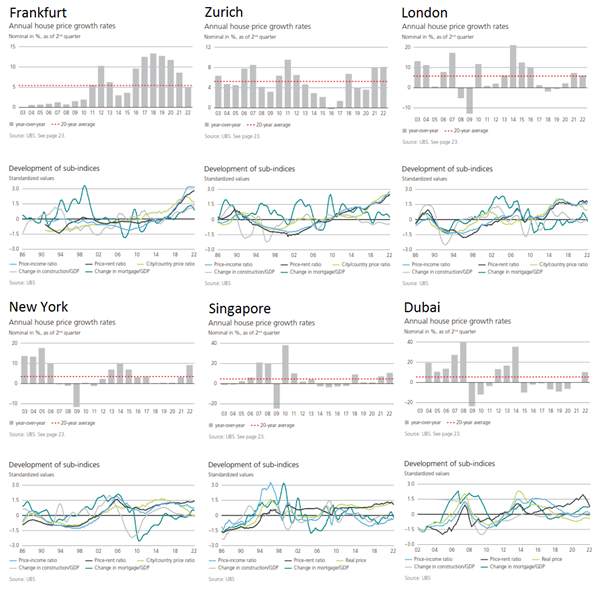
UBS (Oct 11, 2022) - Nominal house price growth in the cities analyzed accelerated to 10% from mid-2021 to mid-2022, representing the highest increase since 2007. Four US cities — Miami, Los Angeles, San Francisco, and Boston — are among the top five with the fastest-growing prices.
 

Imbalances
are sky-high in both analyzed Canadian cities, with Toronto topping the index. Valuations in Frankfurt, Zurich, Munich, and Amsterdam also show elevated risks in Europe. In contrast, there is no bubble risk in the US cities. Since last year, mortgage rates have almost doubled on average across the cities analyzed. Alongside increased prices, this makes city housing much less affordable. A skilled service sector worker can afford roughly one-third less housing space than before the pandemic. 
 
 
In almost all cities, households have been leveraging up. Outstanding mortgages recorded the strongest increase since 2008. Debt-to-GDP is on the rise as well, reflecting the cheap financing conditions and weak economic growth since the pandemic. People have returned to the cities. Strong household formation and unaffordable owner-occupied housing drove demand for rental units. As a result, rents grew by 7% on average last year, making up all rental losses accumulated during the first year of pandemic. Higher interest rates, inflation, turmoil in the financial markets, and deteriorating economic conditions are putting the housing boom under pressure. In a majority of cities with high valuations, price corrections have either already begun, or are expected to start in the coming quarters [...] 

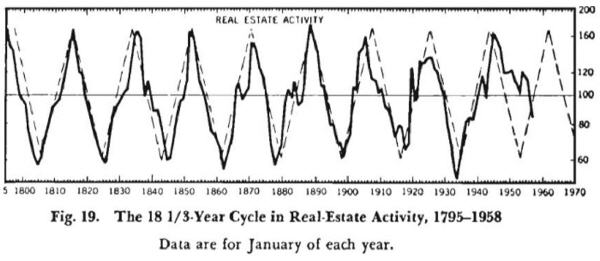
Edward R. Dewey & Edwin F. Dakin, 1947:
"No matter what index be used, this 18-year cycle rhythm seems one of the clearest,
most regular patterns revealed in our economic life.
"
 
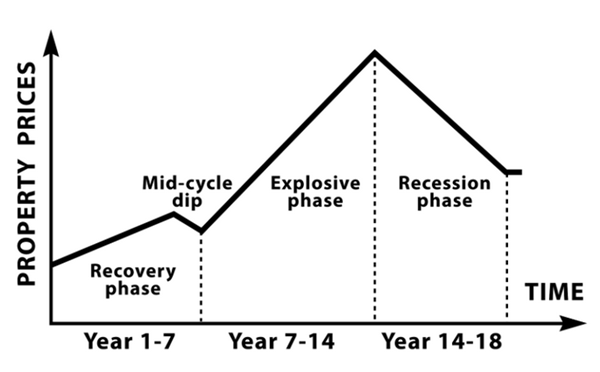
In 1947 Edward R. Dewey and Edwin F. Dakin showed that 18.6 year real estate cycles have repeated over centuries: in times of inflation or deflation, whether interest rates are high or low, with or without trade barriers, with government subsidies, and with high, low or no taxes. Fred Harrison demonstrated considerable economic predictive power relating to this 18.6 year cycle pattern: 14 years up, interrupted by a mid-cycle dip, followed by 4 years down. In over two centuries, this cycle has only ever been disrupted by two world wars. The cycle has never been shorter than 17 years, or longer than 21.
Dewey and Dakin wrote: "The building cycle is so long that few people experience two complete cycles in their business life. Education, to be effective, must therefore be “book knowledge” rather than experience […] For many individuals, an unfavorable first experience means a lifetime tragedy […] The welfare of an individual is often determined by the time in which he was born. If he is old enough to start business at the low of a business cycle, which is accompanied by […] rising prices, his chances for success are very good. Conversely, if he is born at such a date that he starts in business at the peak of a building cycle, which is accompanied by falling commodity prices, his chances of success are small. Much of the success or failure of an individual is due to forces over which he has no control; but if he understands these forces, he may protect himself from the worst results of unfavorable combinations and profit personally from favorable combinations."
 
All cycles have the same characteristics, but different influences, and government intervention in markets cannot create or suppress the real estate cycles. Credit, created by banks, through fractional reserve banking, fuels the cycle. Each recession brings new rules and regulations to the banking industry, designed to stop problems and prevent abuses; each upturn brings new ways to profit by exploiting loopholes in those rules and regulations. 
 
Residential real estate is first to recover from a downturn. The mid-cycle slowdown is confusing: The 18-year cycle is so long that few people remember the last one, and when market expansion quickly resumes, people think everything is fine. But the coming downturn will always be much worse than a mid-cycle slowdown. In the final years of a cycle, authorities congratulate themselves on how well they are managing things. If banks know the government will bail them out, why be prudent in lending. Seeing huge returns of others, the masses rush into real estate investing, believing it never goes down until fear overtakes greed. Land values peak about 12-24 months before a recession. 
 
A peak in the building cycle usually follows peak in land values, but precedes the recession. Announcement of the next ‘world’s tallest building’ may well be the most reliable indicator of an approaching peak. Copper prices spike into the last years of each real estate cycle. In the US all recessions since 1960 have been preceded by an inverted yield curve. The turning point in a cycle is often the collapse, or near collapse, of a major bank; some event will arise to cause doubt, but you’ll hear assurances that everything is okay. 
 
The crisis at the end always comes in an environment of rising interest rates, and the stock market is first to trough because of its far greater liquidity. Investors, speculators, and homeowners with little equity at the end of a cycle will always be wiped out. Always. Recovery takes years, not months. Historically, prices have dropped 20-30% from previous peaks. In the US the 18.6 Year Real Estate Cycle is expected to peak and crash again around 2025 - 2026.
 
 
See also: