Showing posts sorted by relevance for query George Douglass Taylor. Sort by date Show all posts

Tuesday, June 18, 2024

George Taylor's Three-Day Trading Cycle | Scott Hoffman

In my opinion, George Douglass Taylor was one of the greatest trading thinkers, and luckily he left behind one book on trading: 'The Taylor Trading Technique' (1950). This book lays out his 'Taylor Book Method' for swing trading in futures. Taylor postulated that the markets had patterns based on "market engineering" from the "powers that be" in the grain markets. These insiders would frequently cause prices to decline to set up a buying opportunity for themselves. Then, after the market rallied sufficiently to yield profit for these insiders, a short-term top was created to give them a selling opportunity. The market would sell off, and the cycle would start again. 
 
George Douglass Taylor was a grain trader in the 1940s and 1950s at the CBOT pit
and is credited original author of the 3 Day Cycle Short-Term Trading System.

The effect of this engineering was to amplify the natural rhythm of the market, creating false moves that would fool traders into buying when they should be selling, and vice versa. The thrust of the Taylor Technique is to identify this rhythm and take advantage of the "false moves". I have long maintained that if an individual could identify moves in the market that would serve to inflict the most pain on unwary traders then they would have a great trading system. I believe the Taylor Technique does that. Taylor created this method for the grain futures markets, but I find it equally applicable in the financial futures markets today. 
 
George Taylor's Three-Day Trading Cycle.

George Douglass Taylor’s system of short-term swing trading is based on the premise that the market moves in two to three day timeframes, moving from a low to a high and back to a low. The other important concepts are the importance of the previous day’s high and low, the length of upswings relative to downswings, and being a solely technical trader (ignoring fundamentals).

Cycle Day #1 – Buy Day
The first day of the cycle is the buying day. Look for a Buy Day two days after a swing high (the highest high of the past few days). On a Buy Day, look for the market to make its lows first, finding support around yesterday’s low. If the market opens flat to higher, look to buy the first sell off towards the previous low. If the market trades under yesterday’s low, be careful about going home long. The market should close higher than where it opened. If it is making new lows late in the day, it is usually best to exit. You can often get in the next day at a better price.
 
Cycle Day #1 - Buy Day

Generally, it’s good rule of thumb not to buy late in the day on a buy day if the market is heading lower or closing lower than where it opened. Odds favor a lower opening the next day, giving you a better enter price. Likewise, if the market is going to close lower than it opened, don’t be afraid to liquidate your position. Odds are in your favor that you’ll be able to buy at a lower price the next day.

Cycle Day #2 – Sell Day
If you are long and the market is closing in your favor, carry your long position overnight. Odds favor a higher opening the next day setting up the Sell Day, the second day of the cycle. On the Sell Day you should look to sell into strength, liquidating your position, and going home flat. Often, the sell day trades on both sides in what I call a 'fade' day. A fade day often follows a trend day and can be traded from either side.

 Cycle Day #2 - Sell Day

Cycle Day #3 – Sell Short Day
The third day of the cycle is the Sell Short Day. The Sell Short Day is the mirror image of the buying day. On a sell short day, you should be looking to sell early morning resistance, looking for resistance around the previous day’s high. The market should not be making highs late in the day, if it is you should be able to get a better entry point the next day. On a Sell Short Day, the market should close lower than it opened. The Sell Short Day is often followed by a 'Fade' day.
 
Cycle Day #3 - Sell Short Day.

That is the gist of Taylor’s technique - a rhythm of buy-sell-sell short. I don’t always recognize where we are in Taylor’s cycle (you’re always learning!), but on days when it is clear, at the least it gives you a good indication of the market’s bias for that day. In swing trading, the relation of the open to the close should indicate the direction of the next morning’s opening. This helps you determine whether the odds favor being a buyer or a seller on a given day.

Reference:

Sunday, September 25, 2022

Swing Trading: Rules and Philosophy | Linda Bradford Raschke

My style is based on the Taylor Trading Technique, a short-term method for trading daily price movements that relies entirely on odds and percentages. It is a method as opposed to a system. Very few people can blindly follow a system, though many find it easier to be discretionary in a systematic way. 
 
Z = Zigzag Day (Sell Day or Exit Day). This represents a consolidation or reversal-type day within the cycle, often where the market shows a zigzag pattern, allowing for exits or potential fades. It is a key transitional day.
B = Buy Day. This indicates a day favorable for initiating long positions or where buying pressure is expected based on the cycle count.
SS = Sell (or Short) Day. This marks a day biased toward selling or shorting, often part of the reaction or reversal phase in the cycle.
The labels in the chart above derive from Raschke's adaptation of the Taylor Trading Technique, which uses short-term (primarily 2-5 day) rhythmic cycles based on odds, previous highs/lows, and momentum shifts (often incorporating 2-period Rate of Change). The labels help traders anticipate the "correct play" each day. Her chart above illustrates four variations of market cycles using the B/Z/SS sequence. These are short-term swing cycles (typically 4-5 days) observed in daily charts:
 
(14-Day Cycle (Normal): Sequence: B → Z → SS → B → Z → SS... A balanced cycle with alternating buying, zigzag/consolidation, and selling pressure. Suitable for typical ranging or mildly trending markets.
(25-Day Cycle (Uptrend, Low First): Sequence: B → Z → Z → SS → B → Z... Shows extension in the upward direction with an extra Z (zigzag/consolidation) day. Emphasizes buying opportunities after lows in an overall bullish bias.
(35-Day Cycle (Normal): Sequence: B → Z → SS → Z → B → Z → SS... A standard longer cycle incorporating more reaction days (Z and SS), common in moderate conditions.
(44-Day Cycle (Downtrend): Sequence: B → S (Z) → SS → B → Z → SS... Biased toward downward movement, with stronger selling (SS) phases. Note the "S (Z)" indicating a sell-oriented zigzag.


These cycles reflect the market's tendency to alternate between expansion and contraction, with primary direction moves often lasting 4 days in strong trends and reactions being shorter (1 day). Raschke provides a clear, rule-based mechanical approach and sequence to timing entries:

Start searching for a buying day 2 days after a swing high, or conversely, a shorting day 2 days after a swing low. Ideally, markets move in complete 5-day cycles. In a strong trend, expect 4 days in the primary direction and only 1 day of reaction—thus, seek entry 1 day earlier than the standard count.

Look for the market to test the previous day’s low (for longs) or high (for shorts) early in the day, then reverse to form a "check mark" pattern. This creates a strong support/resistance point (double stop point) for better risk management. Avoid entries with only a single stop point, as they suggest counter-trend weakness.
■ Entries should align with the anticipated cycle day (B for longs, SS for shorts). Use objective points like the prior day's high/low. If the trade doesn't perform quickly, exit on the first reaction. Focus on minimizing risk and anticipating rather than reacting.

Her framework emphasizes discipline, probability, and position management over prediction. It is best applied in markets with sufficient volatility and swing potential. Always combine with risk rules (e.g., tight stops for swings) and personal observation of the specific instrument.

 
Because of the short-term nature of this technique, swing traders must adhere to some very basic rules, including: 
 
If the trade moves in your favor, carry it overnight--the odds favor follow-through. Expect to exit the next day around the objective point. An overnight gap presents an excellent opportunity to take profits. Concentrating on only one entry or one exit per day relieves the pressure. 
If your entry is correct, the market should move favorably almost immediately. It may come back to test and/or exceed your entry point a little, but that's OK. 
Do not carry a losing position overnight. Exit and play for better position the next day. 
A strong close indicates a strong opening the following day. 
If the market doesn't perform as expected, exit on the first reaction. 
If the market offers you a windfall of big profits, take them to the bank on the close. 
If you are long and the market closes flat, indicating a lower opening the following day, scratch or exit the trade. Play for better position the next day. 
It is always OK to scratch a trade! 
Use tight stops when swing trading (wider stops when trading trend). 
The goal always is to minimize risk and create "Freebies." 
When in doubt--get out! You have lost your road map and your game plan! 
Place your orders at the market. 
When the trade isn't working, exit on the first reaction. ANTICIPATE! 
 
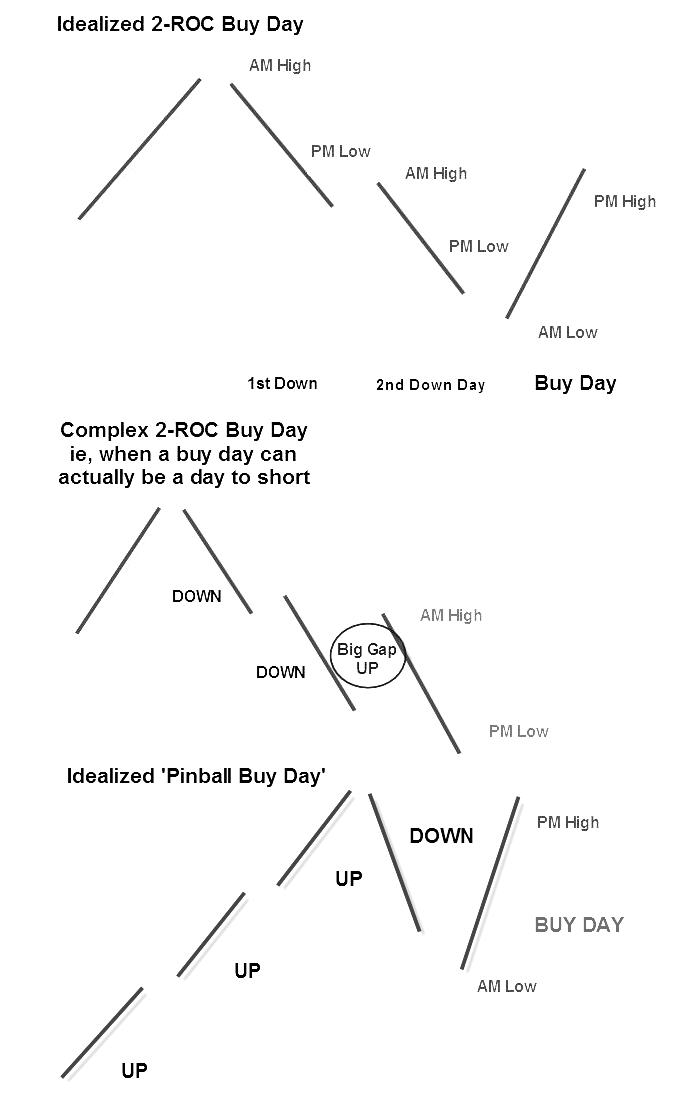
The chart above provides a clear visual guide to three distinct structural variations of Taylor's buying sequences, mapped out as zig-zag swing lines that track morning (AM) and afternoon (PM) price trajectories across consecutive days.

Idealized 2-ROC Buy Day: The top diagram  illustrates the classic two-day Rate of Change (ROC) decline that sets up a standard long entry. The sequence begins with a "1st Down" day, which climbs early to an AM High before dropping to a PM Low. This bearish behavior repeats on the "2nd Down Day," which similarly creates an AM High and finishes weak at a PM Low, cementing a consecutive two-day drop. This multi-day decline perfectly coils the market for the scheduled "Buy Day." On this third day, the rhythm flips; the market drives downward to establish an AM Low first, which tests support and traps late breakout sellers, before reversing into a strong upward rally that finishes at a PM High.

Complex 2-ROC Buy Day (When a Buy Day Can Actually Be a Day to Short): The middle diagram outlines a critical structural exception, demonstrating how a scheduled buying session can twist into a highly effective shorting opportunity. The market pushes steadily downward over the preceding days, setting the stage for what traders expect to be a standard morning dip to buy. However, the market opens with a massive, disruptive change in behavior labeled as a circled "Big Gap UP." This massive open completely ruins the expected rhythm; instead of probing downward for a low, the market hits its AM High immediately at the opening bell. Because the buying pressure is completely exhausted by the gap, the price spends the rest of the day trending downward into a PM Low, transforming the scheduled Buy Day into a short trade.

Idealized 'Pinball Buy Day:' The bottom diagram details the "Pinball" variation popularized by Linda Raschke, which adapts Taylor's concepts to high-momentum uptrends. The sequence begins with a powerful, multi-day expansion consisting of three consecutive "UP" sessions. Following this extended run, the market experiences a sharp, one-day counter-trend flush labeled as a "DOWN" day. This sudden drop serves to shake out weak longs and reset overbought conditions without damaging the broader bullish framework. This single down day triggers the "BUY DAY" on the very next session, where the price dips early to find an AM Low before aggressively reversing upward to close at a PM High, seamlessly resuming the dominant uptrend.
How does one anticipate entry? The following may be indicators of a buy day or a sell day:

The Count
Start searching for a buying day 2 days after a swing high or, conversely, a shorting day 2 days after a swing low. Ideally, the market will move in complete 5-day cycles. (In a strong trend, the market will move 4 days in the primary direction and only 1 in reaction. Thus, one must seek entry 1 day earlier.)
 
"Check Mark" on the Test
The potential entry is sought opposite, or contrary to, the previous day's close. If looking to buy (sell), one first wants the market to "test" the previous day's low (high), preferably early in the day, and then form a trading pattern that looks like a "check mark" (see examples). This pattern sets up and establishes a "double stop point" or strong support. If entering a market with only a "single stop point" or support formed by today's low only, exit on the same day--the trade is clearly against the trend.

Close vs. Open
The close should indicate the following day's opening. When a market opens opposite what is expected or indicated by the trend, one may first look to "fade" it--but must take profits quickly. Then look to reverse!

Support (Resistance)
Is today's support (resistance) higher or lower than yesterday's?

Swing Measurements
Where is the market relative to the last swing high or low? Look for swings (up or down) of equal length, and for retracements of equal percentage.

No matter in what time frame, always look for supply at tops and support at bottoms. Penetrations should be accompanied by volume and activity. Expect trends, either up or down, to last for either 2 or 4 weeks. The following conditions are fairly reliable indicators for the start of one of these trends (I personally skip the first buy or sell swing when one occurs because the move ensuing could be quite strong): 
 
Narrowest range in the last 7 days 
3 consecutive days with small range
The point of a wedge
A breakaway gap 
 A rising ADX (14-period) above 32
Practice
Because a certain amount of confidence in any technique is required to trade it consistently, paper trading can cultivate the faith necessary to recognize and trade pattern repetition. Although the temptation to try too many different styles and patterns always exists, one must strive ultimately to trade in just one consistent manner or at least to integrate techniques into your own unique philosophy.
 
System Characteristics
Certain points about trading short-term swings deserve note. Understanding the nature of short-term systems can help you recognize the psychological aspect of trading. When consistently following a short-term system, you should expect a very high win/loss ratio. Though the objectives with this style of swing trading appear conservative, you will almost always incur "positive slippage". In all systems, winners are skewed. Even though making steady profits, 3-4 really big trades may actually make the month. It is vitally important to always "lock in" your trades. Don't give back profits when short-term trading. You may be astonished at just how big some winners may be from catching the swings "just right!"
 
[...] Finally, I want to leave you with what I believe are two Golden Rules, applicable to all traders but, of essential importance to short-term swing traders: 
 
NEVER, ever, average a loss! Sell out if you think you are wrong. Buy back when you believe you are right.
NEVER, NEVER, NEVER listen to anyone else's opinion! Only YOU know when your trade isn't working.
  
 
See also:

Sunday, May 31, 2026

A 3-Day Cycle Framework for ES and NQ Intraday Trading | Manny_Trends

This 3-Day Cycle Framework is a highly advanced proprietary methodology for intraday market timing and structural analysis, developed by trader @manny_trends (Manny) for trading the ES_F (E-mini S&P 500 futures), NQ_F (E-mini Nasdaq-100 futures), and related instruments like SPX (S&P 500 Index). It integrates price structure (the "WHERE"), precise time-based windows (the "WHEN"), and order flow confirmation (the "WHETHER") to identify high-probability swing points and turning zones during the US regular trading session (9:30 AM – 4:00 PM ET).

Example of a S4H on Cycle Day 1: A high-probability setup in the 3-Day Cycle Framework, combining the highly rotational Series 4 High-first (S4H) pattern with the strongest market structure (Cycle Day 1), typically producing clear 5-swing intraday sequences, offering excellent timing precision and risk/reward  trading opportunities: Morning High between 10:00–10:55 (centered 10:30), Midday low between 11:00–11:45 (11:15), Lunch Hour High between 12:00–1:00 (12:20), Afternoon Low around 2:00–2:55,  and Late-Day High around 3:00–3:57.
The framework is built on observed recurring rhythms in equity index futures. It combines intraday seasonality, liquidity dynamics, dealer positioning awareness (including GEX — Gamma Exposure), and real-time order flow. It strongly emphasizes reaction over prediction, using the Market Blueprint as a daily operating plan. Traders wait for price to reach mapped levels within specific timing windows, confirmed by order flow, volume, and broader market context.
 
Cycle Progression and Reset (CD1, CD2, CD3)
Markets operate in a recurring 3-day rhythm. Each trading day is assigned a Cycle Day (also abbreviated CD) that modulates the expected behavior, swing clarity, and suitable Time-Series.

► Cycle Day 1 (CD1): Often described as one of the strongest and most predictable setups, particularly with S4. It typically features simpler 3-swing patterns (S1H/S1L) with cleaner trend potential and excellent risk/reward.
► Cycle Day 2 (CD2): A transitional day with increased rotation. It commonly uses S4 variants (5 swings), producing more alternating moves and tighter midday windows.
► Cycle Day 3 (CD3): Frequently rotational with strong late-day emphasis. It often employs S2 (4 swings) or S4 patterns, supporting multi-leg trades and power-hour action. 

The cycle follows a standard sequence of Cycle Day 1 Cycle Day 2 Cycle Day 3, and then resets back to Cycle Day 1. The cycle advances with each consecutive trading session, skipping weekends and holidays. After Cycle Day 3, the next trading day automatically returns to Cycle Day 1, creating a consistent and reliable three-day rhythm. 
 
Example of a S3L on Cycle Day 2: Combines Series 3 Low-first (S3L) 4-5-swing pattern with Cycle Day 2, typically featuring a morning low, midday high, lunch hour low, afternoon high, and a low into the session close in the ES_F.
Time-Series and Intraday Swing Patterns
Time-Series define the expected sequence, direction, and timing of intraday swing highs and lows. They are labeled as follows:

► S stands for Series.
► The number (1, 2, 3, and 4) indicates the pattern variant and typical number of swings.
► H = High-first bias (the sequence begins with an expected swing high).
► L = Low-first bias (the sequence begins with an expected swing low).

These are probabilistic windows, not exact times. Price action tends to gravitate toward the center times within each window for potential reversals or extremes. 
 
A specific time series and daily high- or low-bias are determined for each Cycle Day before the regular trading session opens, based on overnight inventory, gap direction, the opening range, and broader market structure. Developing this skill requires extensive study of historical cycle progressions and the experience to recognize what is likely to unfold next, enabling traders to align their execution with the market's sequential development.
  
The following table offers a detailed comparison of all three Cycle Days combined with the complete set of eight Time-Series patterns, encompassing both High-First and Low-First variants for Time-Series 1, 2, 3, and 4:

How to read this table: E.g., a S1H Cycle Day 1 is expected to present 3 swings between 9:30 a.m. and 4:00 p.m, a High first in the Morning between 10:00–10:55 (centered 10:30), a Midday Low between 11:00–12:15 (centered ~11:45), an Afternoon High between 2:00–2:55 (centered 2:30), and no strong 3:00–3:57 Late-Day swing window. The trading day usually winds down after 2:30 p.m.
Note: The exact Time-Series and Reversal Time Windows vary daily based on overnight and London Session Price Action, gap direction, and prior structure. S4 variants are highly regarded across Cycle Days for their activity level.
Market Blueprint
Manny's Market Blueprint is a complete daily pre-market plan. It combines:

► WHERE (Price Structure): Key support/resistance levels, Prior Day High/Low (PDH/PDL), overnight extremes, gamma-related zones, round numbers, and LB&F traps.
► WHEN (Execution Clock): Cycle Day + Time-Series windows that filter when those levels are most likely to be respected.
 
Example of a S1H on Cycle Day 2: Combines Series 1 High-first (S1H) 3-swing pattern with the transitional and rotational nature of Cycle Day 2, typically featuring a morning high, midday low, and afternoon high, suitable for moderate clarity rotational trading in ES_F.
The greatest edge occurs at confluence: a mapped price level aligning with a timing window. Manny repeatedly emphasizes: "React. Don’t predict.", and "Price + Time = Edge."

Liquidity Grab-and-Fail Traps
LB&F stands for Liquidity Buy & Fail (also referred to as Liquidity Grab & Fail). These are engineered liquidity traps designed to capture stop-loss orders and induce retail traders into poor positions before a reversal.

A LB&F trap occurs when price briefly sweeps below a significant low or liquidity pool (such as equal lows, PDH/PDL, round numbers, or gamma-related zones), triggering stops or inducing short entries. Sellers then fail to sustain the downside momentum. Responsive buyers step in aggressively, causing a rapid reclaim above the swept level. This creates a trap for those who entered on the breakdown, while offering a high-probability reversal for disciplined traders.

Key Characteristics:
► Price sweeps a mapped support level.
► Failure to accelerate lower despite increased volume.
► Rapid reclaim with order flow confirmation (positive delta shift, absorption, and buying tails).

ES_F Examples:
► Sweep below 6,716 that fails, followed by sharp reclaim.
► Liquidity grab under 6,750 handle, then fast recovery with buyer aggression.
► Sweep below 6,773 with immediate responsive buying.

LB&F setups are plotted on the Market Blueprint and gain power when aligned with Cycle Day timing windows and confirmed by order flow.

Order Flow Confirmation Techniques
Order flow serves as the essential real-time filter that validates whether a potential setup is likely to hold or reverse.

Core Concepts:
► Responsive buying or selling at key levels.
► Absorption: Large passive orders absorbing aggressive market orders with minimal price progression.
► Delta divergence, buying/selling tails, and reclaims after liquidity sweeps.

Primary Techniques:
1. Swift rejection and absorption at mapped levels during a Time-Series window. 
2. LB&F trap confirmation via liquidity sweep followed by rapid reclaim.
3. Delta divergence and balance at resistance or support.
4. Tape reading for sustained aggressive flow aligning with the expected bias.

A high-probability trade requires full alignment of Cycle Day, Time-Series window, Blueprint level (including LB&F), and confirmed order flow.

Practical Trading Application and Principles
Traders follow this process:
 
1. Pre-market: Determine Cycle Day and Series, construct the Market Blueprint with levels and timing overlays.
2. During session: Exercise patience. React only when price reaches a confluence zone supported by order flow.
3. Risk Management: Tight stops (8 points in ES_F), defined targets (5/10/15/20-point structure), strict discipline. 
 
Avoid chasing or emotional trading.

Key Principles
This 3-Day Cycle Framework provides a repeatable, probabilistic structure for disciplined intraday trading. All elements function as guides rather than guarantees and perform best when combined with sound risk management and broader market context.
  
Price + Time + Order Flow = Edge.
React, do not predict.
Confluence is essential.
The framework supports both scalping and short-term swings while maintaining institutional-grade structure through gamma awareness and liquidity concepts.
It is dynamic, adjusting to different market regimes (e.g., high-gamma pinning versus expansion).
 
Parallels with George Douglass Taylor's 3-Day Cycle
There are strong conceptual parallels between Manny's framework and George Douglass Taylor's 3-Day Cycle (from his 1950s "Book Method")
 
 
Key Similarity: Both systems view the market as having a natural 3-day rhythm driven by institutional behavior, where Day 1 tends to be the strongest/trendiest, and the cycle reliably resets after Day 3.
 
Main Difference: Taylor's method is more price-action and day-type focused (Buy/Sell/Sell Short). Manny's version is heavily enhanced with precise intraday timing windows (Time-Series), LB&F traps, gamma awareness, and order flow confirmation. 

More Cycle Day and Time Series Examples
Manny heavily promotes Cycle Day 1 in his public X content (especially with S4). Cycle Day 2 and Cycle Day 3 are mentioned far less often with clear text labels in public tweets — they are more commonly implied through the daily sequence or discussed inside his private community (The Pit).
 
Example of a S1L on Cycle Day 2: A low-first bias setup, combining the simpler Series 1 Low-first (S1L) 3-swing pattern with the transitional and rotational nature of Cycle Day 2, typically featuring an early low, midday high, and afternoon low, suitable for moderate clarity rotational trading opportunities.

Example of a S2H on Cycle Day 3: A high-first bias setup, combining the intermediate Series 2 High-first (S2H) 4-swing pattern with the rotational and late-day emphasis of Cycle Day 3, typically featuring a morning high, broad midday low, afternoon high, and late-day low into the close, offering balanced rotational trading opportunities.  
More examples for Cycle Day 1:
2026 May 20 (Wed) S4L Cycle Day 1 https://x.com/manny_trends/status/2057082663182258506
2026 May 19 (Tue) S3H Cycle Day 1 https://x.com/manny_trends/status/2056732087705579604
2026 May 04 (Mon) S4  Cycle Day 1 https://x.com/manny_trends/status/2051278725652570365
2026 Mar 26 (Thu) S1H Cycle Day 1  — https://x.com/manny_trends/status/2037155860233982089
2025 Oct 07 (Tue) S3H Cycle Day 1  — https://x.com/manny_trends/status/1975550427006472499

More examples for Cycle Day 2:
2025 Oct 16 (Thu) Cycle Day 2 S4H — https://x.com/manny_trends/status/1978810199939924066
2025 Oct 08 (Wed) Cycle Day 2 S4L — https://x.com/manny_trends/status/1975909043752296709

More examples for Cycle Day 3:
2025 Oct 14 (Tue) S2H Cycle Day 3 https://x.com/manny_trends/status/1978085659203035605
2025 Oct 10 (Fri) 3 S2L Cycle Day 3 https://x.com/manny_trends/status/1976633829101347124
2025 Oct 09 (Thu) S1H Cycle Day 3  — https://x.com/manny_trends/status/1976271429109940274