Another interesting example, Hindu deities have 108 names, whilst in Gaudiya Vaishnavism, there are 108 gopis of Vrindavan. Recital of these names, often accompanied by the counting of the 108-beaded Mala, is considered sacred and often done during religious ceremonies. The recital is called namajapa. Accordingly, a mala usually has beads for 108 repetitions of a mantra. 108 sacred books constitute the holy writings for Tibetans. The Vedanta, according to the Hinduism tradition, recognizes 108 authentic doctrines (Upanishad) aiming to approach the Truth and to destroy Ignorance. In Jain tradition is believed that they are 108 virtues. Lankavatara Sutra ancient teachings refer repeatedly to many temples with 108 steps. In Tibetan Buddhism it is believed that there are 108 sins or 108 delusions of the mind. In some schools of Buddhism, it is believed that there are 108 defilements. In Japan, at the end of the year, a bell is chimed 108 times in Buddhist temples to finish the old year and welcome the new one. Each ring represents one of 108 earthly temptations a person must overcome to achieve nirvana. Likewise, Zen priests wear juzu, a ring of prayer beads, around their wrists, which consists of 108 beads. The Lankavatara Sutra has a section where the Bodhisattva Mahamati asks Buddha 108 questions. The Buddhism tradition talks about the 108 earthly desires in mortals, 108 lies humans tell and 108human delusions. The esoteric presence of the number 108 can be seen in various spiritual practices and theories: In Kriya Yoga, the maximum number of repetitions allowed to be practiced in one sitting is 108. Also, 108 Sun Salutations in yoga practice is often used to honor change, for example the change of seasons, or at a time of tragedy to bring peace, respect and understanding. It is said that if one can be so calm in meditation practicing pranayama to have only 108 breaths a day that enlightenment will come.
There are said to be 108 energy lines, or nadis, converging to form the heart chakra. Marma points are like Chakras, or intersection of energy, with fewer converging energy lines. On Sri Yantra, the Marmas have 54 intersecting energy lines where three lines intersect. Each has feminine, or shakti, and masculine, or shiva, qualities. 54 x 2 = 108. Therefore there are 108 points that define the human body and the Sri Yantra or the Yantra of Creation. The same rule is observed in the Sanskrit language, with its 54 letters, both representing the two genders and they are also called Shiva and Shakti respectively; again, 54 x 2= 108.

The earth cycle is supposed to be of 2160 years = 20 x 108. The distance between the Earth and Sun is 108 times the diameter of the Sun. The diameter of the Sun is 108 times the diameter of the Earth. The distance between the Earth and Moon is 108 times the diameter of the Moon. The universe is made up of 108 elements according to ancient texts. The current periodic table claims a few more than 108.
There are 12 constellation and 9 arc segments. 9 times 12 equal 108. The 9 planets travelling through the 12 signs constitute the whole of existence. 9 x 12 = 108. The 27 nakshatras or lunar constellations spread over the 4 elements – fire, earth, air, water or the 4 directions – north, south, east, and west. This also constitutes the whole of existence. 27 x 4 = 108.
 |
1. The Sun is 108 times bigger than the Earth
2. The distance from the Earth to the Sun is equal to 108 Suns side by side
3. The distance from the Earth to the Moon is 108 Moons side by side. |
The Number 108 in Numerology
1 stands for God or higher Truth, 0 stands for
emptiness or completeness in spiritual practice,
and 8 stands for
infinity or eternity.
Powers of 1, 2, and 3 in math: 1 to 1st power =1; 2 to 2nd power = 4 (2 x 2); 3 to 3rd power = 27 (3 x 3 x 3). 1 x 4 x 27 =108
Breath: In one minute, we breathe in approximately 15 times, in 1 hour 900 times, and in 12 hours 10800 times, and in a day 10800 x 2 times. A day consists of 24 hours, and if we set aside half the day for our day to day routines, then one can spend 12 hours for recitation of one's idol. Therefore, the maximum number of times that one can recite "mantra", or perform "Jap" are 10800. If one wants to obtain 100% benefit of its jap, then performing jap 108 times will give you the benefit of 100%. That's why in a "Mala", there are 108 beads. It is written in Vedas, that 1 Jap corresponds to 1 mala (which has 108 beads), therefore performing jap of 108 malas will result in 100% benefit.
Astronomy: There are 27 constellations in our galaxy, and each one them has 4 directions, and 27 x 4 = 108, In other words the number 108 covers the whole galaxy.
Indian scriptures: The letter 9 corresponds to Lord Brahma (the creator of universe). Mathematically, the interesting property of
9 is 9 x 1 = 9
9 x 2 = 18 (8+1=9)
9 x 3 = 27 (7+2=9)
9 x 12 = 108 (1+0+8=9)
In Hindu religion, number 9 is very important. Keeping the importance of number 9, Rishi Vyas has created 9 Purans, 108 MahaPuran (Upnishads). Mahabharat has 18 chapters, Geeta has 18 chapters, Bhagavat has 108000 Shloks (verses).
The addition of digits of number 108is 9, and number 9 is related with Brahma, that's why 108 is very important, and came into lot of Indian scriptures.
Indian Vedas, treats the Sun as God, and Sun has 12 signs (Zodiac signs). In Yajurved, Sun is related with Lord Brahma (the number 9), remember - 12 x 9 = 108; therefore for Gods Prayer, the number 108 is very sacred.
According to Indian mythology, there are 4 Yugas
SatYuga - consists of 172,800 years 1+7+2+8 = 18 = 1+8 = 9
TretaYuga consists of 1296000 years 1+2+9+6 = 18 = 1+8 = 9
DwaparYuga consists of 864000 years 8+4+6 = 18 = 1+8 = 9
KaliYuga consists of 432000 years 4+3+2 = 9
Harshad number: 108 is a Harshad number, which is an integer divisible by the sum of its digits (Harshad is from Sanskrit, and means "great joy")
Desires: There are said to be 108 earthly desires in mortals.
Lies: There are said to be 108 lies that humans tell.
Delusions: There are said to be 108 human delusions or forms of ignorance.
Heart Chakra: The chakras are the intersections of energy lines, and there are said to be a total of 108 energy lines converging to form the heart chakra. One of them, sushumna leads to the crown chakra, and is said to be the path to Self-realization.
Sanskrit alphabet: There are 54 letters in the Sanskrit alphabet. Each has masculine and feminine, shiva and shakti. 54 times 2 is 108.
Pranayama: If one is able to be so calm in meditation as to have only 108 breaths in a day, enlightenment will come.
Upanishads: Some say there are 108 Upanishads, texts of the wisdom of the ancient sages.
Sri Yantra: On the Sri Yantra there are marmas where three lines intersect, and there are 54 such intersections. Each intersections has masculine and feminine, shiva and shakti qualities. 54 times 2 equals 108. Thus, there are 108 points that define the Sri Yantra as well as the human body. The angle formed by two adjacent lines in a pentagon equals 108 degrees.
Pentagon: The angle formed by two adjacent lines in a pentagon equals 108 degrees.
Marmas: Marmas or marmasthanas are like energy intersections called chakras, except have fewer energy lines converging to form them. There are said to be 108 marmas in the subtle body.
Time: Some say there are 108 feelings, with 36 related to the past, 36 related to the present, and 36 related to the future.
8 extra beads: In doing a practice of counting the number of repetitions of the mala, 100 are counted as completed. The remaining are said to cover errors or omissions. The 8 are also said to be an offering to God and Guru.
Chemistry: Interestingly, there are about 115 elements known on the periodic table of the elements. Most of those, around or higher than the number 100 only exist in the laboratory, and some for only thousandths of a second. The number that naturally exist on Earth is around 100.
Astrology: There are 12 constellations, and 9 arc segments called namshas or chandrakalas. 9 times 12 equals 108. Chandra is the Moon, and kalas are the divisions within a whole.
River Ganga: The sacred River Ganga spans a longitude of 12 degrees (79 to 91), and a latitude of 9 degrees (22 to 31). 12 times 9 equals 108.
Planets and Houses: In astrology, there are 12 houses and 9 planets. 12 times 9 equals 108.
Goddess names: There are said to be 108 Indian goddess names.
Gopis of Krishna: In the Krishna tradition, there were said to be 108 gopis or maid servants of Krishna.
Sun and Earth: The diameter of the Sun is 108 times the diameter of the Earth. The distance from the Sun to the Earth is 108 times the diameter of the Sun.
Moon and Earth: The average distance of the Moon from the Earth is 108 times the diameter of the Moon.
Silver and the Moon: In astrology, the metal silver is said to represent the moon. The atomic weight of silver is 108.
Numerical scale: The 1 of 108, and the 8 of 108, when added together equals 9, which is the number of the numerical scale, i.e. 1, 2, 3 ... 10, etc., where 0 is not a number.
Meditations: Some say there are 108 styles of meditation.
Breath: Tantra estimates the average number of breaths per day at 21,600, of which 10,800 are solar energy, and 10,800 are lunar energy. Multiplying 108 by 100 is 10,800. Multiplying 2 x 10,800 equals 21,600.
Paths to God: Some suggest that there are 108 paths to God.
Smaller divisions: The number 108 is divided, such as in half, third, quarter, or twelfth, so that some malas have 54, 36, 27, or 9 beads.
Hinduism: 108 is said to refer to the number of Hindu deities. Some say that each of the deities has 108 names.
Islam: The number 108 is used in Islam to refer to God.
Jain: In the Jain religion, 108 are the combined virtues of five categories of holy ones, including 12, 8, 36, 25, and 27 virtues respectively.
Sikh: The Sikh tradition has a mala of 108 knots tied in a string of wool, rather than beads.
Buddhism: Some Buddhists carve 108 small Buddhas on a walnut for good luck. Some ring a bell 108 times to celebrate a new year. There are said to be 108 virtues to cultivate and 108 defilements to avoid.
Chinese: The Chinese Buddhists and Taoists use a 108 bead mala, which is called su-chu, and has three dividing beads, so the mala is divided into three parts of 36 each. Chinese astrology says that there are 108 sacred stars.
Stages of the soul: Said that Atman, the human soul or center goes through 108 stages on the journey.
Meru: This is a larger bead, not part of the 108. It is not tied in the sequence of the other beads. It is the quiding bead, the one that marks the beginning and end of the mala.
Dance: There are 108 forms of dance in the Indian traditions.
Praiseworthy souls: There are 108 qualities of praiseworthy soul.
First man in space: The first manned space flight lasted 108 minutes, and was on April 12, 1961 by Yuri Gagarin, a Soviet cosmonaut.
Time: Some say there are 108 feelings, with 36 related to the past, 36 related to the present, and 36 related to the future.

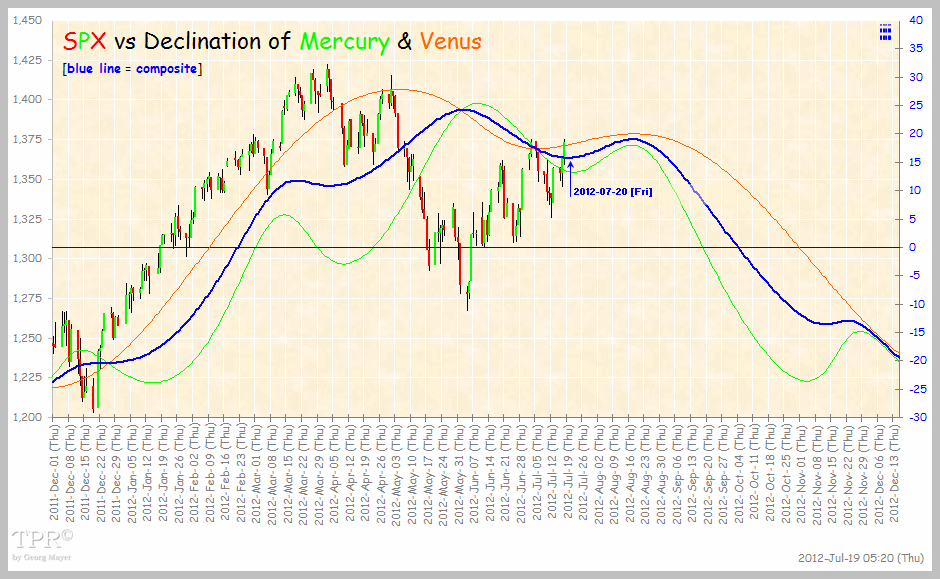


 This week is a STD Green Week, since Monday, July 16th, and Friday, July 20th, are STD Green Days (HERE). Green
Weeks are usually directional. However, this one might see the high of the week as early as by the end of Tuesday.
This week is a STD Green Week, since Monday, July 16th, and Friday, July 20th, are STD Green Days (HERE). Green
Weeks are usually directional. However, this one might see the high of the week as early as by the end of Tuesday. The pattern on Monday, July 16, is expected to mimic last Thursday. Tuesday is a potential STD-inversion-day. On the intermediate-term Delta-scale (ITD), we expect a rally into July 18 +/- = ITD #8 HIGH = MTD #2). As outlined HERE + HERE already, ITD #8 is likely to stay below the July 3-5 ITD #6 HIGH.
  The 4 Year Lunar Cycle suggests that this high will be followed by the immediate decline into late July-early August (= 180 TD LOW = 40 Week Cycle LOW = 9 Month Cycle LOW) as the start of a multi-month decline. The 40 Year Cycle points to a high above the April-May highs.


