Showing posts with label Composite Operator. Show all posts

Friday, March 17, 2023

How Livermore Judges the Turning Points | Richard D. Wyckoff

Judging the main turning points in the long swings is the most important thing that he does, and if he could accomplish nothing else in between the panics and booms and accurately judge the right time for changing his position, he knows that he has a starting point for the rolling up of tremendous profits during the intervening year or two while the market is on its way from nadir to zenith. It is perfectly clear why this is so. A man who loads up at the low point of a panic has a certain amount of working capital. If he succeeds in selling out near the top of the boom, he has not only his original capital but his aggregate profits as well. If he then takes a short position with the line increased by reason of these profits and successfully rides this short line down to the next panic, he will find his resources vastly increased.
 
Quotation Board Girls copying the latest numbers calculated by the
Composite Man to the quotation board
in Waldorf Astoria's lobby to be acknowledged by the crowd as
the price and nothing but the price; New York, 1918.
 
These lines of stocks which Livermore takes on at the low points are not of course, always sold at the topmost prices. As the market executes its series of intermediate swings and begins to approach the level when an important turning point is likely to occur, he looks for more frequent reactions, and, therefore, will very often liquidate all or part of his line on some of the strong bulges which occur in the upper stages of the market, or in what is known as the selling zone. He does not consider it good policy to try and get the last point, for many things can happen which might bring the ultimate turning point nearer than he anticipated. 
 
He knows that all stocks do not make their tops simultaneously. Some reach their apex months before the last of them have exhausted their lifting power. The bull forces may be likened to an army which is carrying the defenses of the enemy: it can advance just so far without becoming exhausted and falling back. He knows that the principal bull ammunition is money and that general conditions govern and limit the extent of any move; also that it is not so much the news, the statistics, the dividends, etc. that are important but what is of dominating importance is the effect of the developments on the minds of men and the extent to which traders and investors are thereby induced to buy or sell. The market is not affected by what a million people think about the market, but it is immediately affected by their actual buying and selling or their failure to do either. 
 
 
While the long swings are of the utmost importance to him, they do not by any means constitute all of his operations. He is an active trader, for long ago he cured himself of jumping in and out of the market day after day.  
 
Next in importance to the trades which he makes are the intermediate swings running from ten to thirty points and from a week or two to a few months in duration. Let us say that the market is getting into the upper levels and although not at the turning point becomes overbought and the technical position is such that a reaction of ten to fifteen points is imminent. He decides that under such conditions it is best for him to reduce his line of long stocks in order that he may take advantage of whatever decline occurs by replacing them at lower prices. He may have twenty or thirty points profit in a certain lot of stock which he believes will sell at a higher figure eventually, but if he can close this out on the verge of a sharp reaction and replace it ten points cheaper, he has thereby reduced the original cost by that much. His judgment of the time and the direction of these intermediate swings can only be formed accurately by the action of the market as recorded on the tape of the ticker. He cannot gauge it properly in any other way. Where else can he see the gradual alteration from strength to weakness in the market; the complete supply of the absorption power; the ultimate weakening of support and the numerous other characteristics of such an episode.

Wyckoff started as a stockbroker's runner at the age of 15,
became a brokerage firm auditor a few years later,
and at age 25 opened his own brokerage firm.

Just as the market displays to his practiced eye the downward phase, so it forecasts the end of the reaction and the time to resume the long side. These indications appear in the leading stocks of important groups and in many individual issues - usually the most popular trading mediums. The principles of judging the market by its own action, Livermore learned long ago and he found that they operate over the whole wide range of stock market movements, from the little half-hourly ripples back and forth to the great swings in prices running from one to three years. It is a question of supply and demand and once recognized and properly applied, it goes a long way toward solving of most stock market problems.


The market moves along the line of least resistance and when demand is greater than supply this line is upward. To detect the momentary changes as well as those taking a longer time to work out, is the daily task of Mr. Livermore, just as it is the business of every manufacturer and merchant to judge the future course of his particular industry.

 
See also:
Richard D. Wyckoff (1910) - Studies in Tape Reading.
Richard D. Wyckoff (1922) - Exposing and Killing the Bucket Shops. 
Edwin Lefèvre (1923) - Jesse Livermore - Reminiscences of a Stock Operator.
Edwin Lefèvre (1925) - The Making of a Stockbroker. 
Richard D. Wyckoff (1930) - Wall Street Ventures & Adventures through Forty Years.
 Richard D. Wyckoff (1931) - The Wyckoff Method of Trading in Stocks. 

Wednesday, December 21, 2022

Accumulation and Distribution Schematics | Richard D. Wyckoff

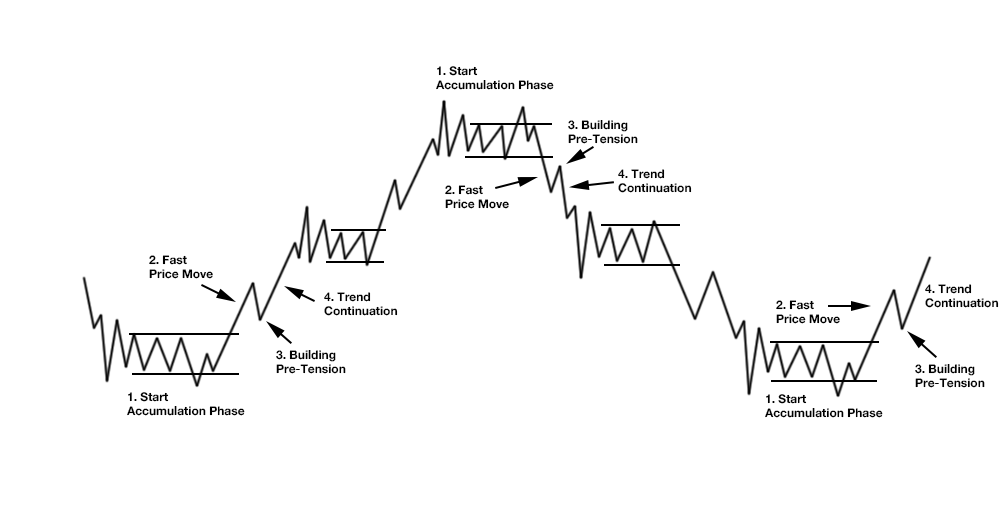
The Wyckoff Method, developed by Richard Wyckoff in the early 1900s, explains how stock (or asset) prices move in cycles driven by big players like institutions or "smart money" (often called the "Composite Man" or market makers). These pros manipulate prices to buy low and sell high, profiting from retail investors (you and me, the "weak hands" who buy/sell based on emotions). 
 
Prices don't move randomly; they follow patterns in four main processes: Accumulation, Markup, Distribution, and Markdown. Within trends, there are pauses called Re-Accumulation (during uptrends) and Re-Distribution (during downtrends). Think of it like a chess game where smart money sets traps to take shares from scared or greedy small traders.
The Overall Market Cycle and Why It Works
Markets cycle: Downtrend → Accumulation → Markup → Distribution → Markdown → Repeat. Smart money (institutions with deep pockets) engineers this by controlling volume and price action. They use news, rumors, and patterns to manipulate psychology—fear at bottoms, greed at tops. Retail reacts emotionally, providing the liquidity (shares to buy/sell) that smart money needs. Tools like volume analysis help spot these phases: High volume on climaxes, low on tests.

To spot in charts: Look for ranges after trends, volume changes, and failed breakouts. Practice on historical charts to see how pros always win by being patient and contrarian.

1. Accumulation: Buying Cheap at the Bottom
This happens after a long price drop (downtrend), when the market hits rock bottom. Everyone's panicking, selling cheap. Smart money sees value and starts secretly buying without driving prices up too fast. 
 
 Accumulation Characteristics.
 
Step 1: Preliminary Support (PS): Prices fall hard, but selling slows as smart money begins quiet buying to stop the drop. Volume (trading amount) is high from panic sellers, but price stabilizes a bit. Market makers absorb shares from weak hands dumping in fear.
Step 2: Selling Climax (SC): A final massive sell-off hits the lowest point. Volume explodes as retail dumps everything. Smart money buys aggressively here, creating a "climax" where selling exhausts itself. Price bounces slightly.
Step 3: Automatic Rally (AR): After the climax, price rises automatically as short-sellers (betting on further drops) cover positions, and some buyers return. This rally is short-lived, testing if selling is over.
Step 4: Secondary Test (ST): Price falls back to re-test the low from the climax, but on lower volume—meaning less selling pressure. If it holds, it confirms smart money has control. They might "spring" the price below support briefly to scare out remaining weak hands and grab their shares cheap.
Step 5: Building the Range: Price moves sideways in a "trading range" (box between support and resistance lines). Smart money accumulates millions of shares discreetly over weeks/months. They use "shakes" (fake drops) to buy more. Volume dries up on down moves (no real selling) and picks up on up moves.
What Market Makers Do: Act like sponges, soaking up supply from fearful sellers without alerting the public. They avoid bidding wars by timing buys during weakness. Goal: Own a huge position at low cost before the uptrend starts.
Other Participants: Retail sells in despair ("capitulation"). Weak institutions might sell too. Smart money traps shorts by not letting prices crash further.
End Sign: "Last Point of Support" (LPS)—a final test where price holds firm on tiny volume. Then, a "Sign of Strength" (SOS): Price breaks above resistance on high volume, starting the uptrend.

Result: Smart money now controls supply, ready to pump prices.
 
2. Markup: The Uptrend Rise
Once accumulated, smart money drives prices up for profit.
  • Prices rise steadily or in waves. Volume increases on up days, decreases on pullbacks.
  • Smart money sells a bit during rises to retail chasing gains (FOMO—fear of missing out), but holds most for higher prices.
  • Pullbacks are shallow; smart money buys dips to keep momentum.
  • This phase can last months/years, with news often turning positive to attract buyers.
3. Distribution: Selling High at the Top
Mirror of accumulation, but at peaks after a long rise. Euphoria peaks; retail buys high. Smart money sells into this greed without crashing prices immediately.
 
 Distribution Characteristics.

Step 1: Preliminary Supply (PSY): Uptrend slows; first signs of heavy selling (supply) appear on high volume, but price doesn't drop much yet. Smart money starts offloading to eager buyers.
Step 2: Buying Climax (BC): Final frenzy—prices spike on huge volume as retail piles in. Smart money dumps massively here.
Step 3: Automatic Reaction (AR): Price falls automatically as buying exhausts. Tests if more demand exists.
Step 4: Secondary Test (ST): Price rallies back to re-test the high, but on lower volume—weak demand. Smart money might "upthrust" (fake breakout above resistance) to trap more buyers, then let it fall.
Step 5: Building the Range: Sideways range forms at the top. Smart money distributes shares to retail. Uses "upthrust after distribution" (UTAD) to fake strength, sucking in bulls before dropping.
What Market Makers Do: Flood the market with supply during hype, using rallies to sell without panic. They create illusions of strength (false breakouts) to offload at peak prices. Goal: Exit positions profitably before the crash.
Other Participants: Retail buys in greed, thinking the uptrend continues. Shorts get squeezed out. Weak hands get trapped holding overpriced assets.
End Sign: "Last Point of Supply" (LPSY)—final weak rally. Then, "Sign of Weakness" (SOW): Price breaks below support on high volume, starting the downtrend.

Result: Smart money cashes out; retail left holding the bag.

4. Markdown: The Downtrend Fall
Prices drop as supply overwhelms demand.
  • Falls in waves, with brief rallies (dead cat bounces) where smart money might short more.
  • Volume high on down days. News turns negative, scaring more sellers.
  • Leads back to accumulation bottom.
5. Re-Accumulation: Pausing During Uptrends
Mid-uptrend pause to "reload." After a rally, momentum fades; smart money consolidates to buy more or shake out weak bulls.
  • Shorter, tighter range than full accumulation.
  • Involves "backing up to the creek" (minor drop to support) or "jumping the creek" (break above resistance).
  • Smart money tests for remaining supply, absorbs it, then resumes markup.
  • Looks like a mini-accumulation: Support tests, low-volume pullbacks, then strong breakout.
  • What Happens: Prevents overheating; smart money builds more positions cheaply during dips, trapping shorts who think the uptrend ended.
6. Re-Distribution: Pausing During Downtrends
Mid-downtrend halt to "reload shorts." Fake recovery attracts buyers, allowing smart money to sell more or initiate shorts.
  • Shorter than full distribution.
  • Uses "upthrusts" or "jump across the creek" (false rallies) to trap longs.
  • Smart money creates liquidity by luring buyers, then dumps to resume markdown.
  • Looks like mini-distribution: False highs, high-volume failures, then breakdown.
  • What Happens: Builds false hope; smart money offloads remaining longs or adds shorts during the fake strength.
 

» An understanding of manipulative procedure in any-event helps us to judge the motives, the hopes, fears and, aspirations of all the buyers and sellers whose actions today have the same net effect upon the market as 30 many pool operations would have. So if we are squeamish about the term "manipulator" we may substitute the words "Composite Operator" with the same force and affect. 

Some people might object to this statement on the ground that regulation of the stock market has eliminated pool operations. Even though pool operations and old-fashioned manipulation are banned by law, for our purpose in studying, understanding and correctly interpreting market action, we must consider any operation a "manufactured" movement wherein the buying or the selling is sufficiently concerted and coming from interests better informed than the public as to produce the same effects as pure manipulation. 
[...] The market is made by the minds of men, and all the fluctuations in the market and in all the various stocks should be studied as if they were the result of one man’s operations. Let us call him the Composite Man, who, in theory, sits behind the scenes and manipulates the stocks to your disadvantage if you do not understand the game as he plays it; and to your great profit if you do understand it. 
Great activity and breadth induces trading in large quantities by big operators on the floor and outside. Such a market enables the manipulator to unload a large line of stock. When he wishes to accumulate a line, he raids the market for that stock, makes it look very weak, and gives it the appearance of heavy liquidation by sending in selling orders through a great number of brokers.
 
You say all this is unethical, if not unscrupulous. You say it is a cruel and crooked game. Very well. Electricity can be very cruel, but you can take advantage of it; you can make it work for your benefit. Just so with the stock market and the Composite Man. Play the game as he plays it. I am giving you the inside view. «
Richard D. Wyckoff
1931 
Richard Wyckoff's market cycle theory centers on accumulation and distribution phases driven by insiders. Accumulation occurs at market bottoms, where sophisticated players discreetly buy assets over months without spiking prices. It begins with preliminary support, stabilizing prices, followed by a selling climax where panic selling exhausts, allowing insiders to absorb shares. Secondary tests confirm this, forming a sideways range where insiders accumulate without attracting attention. Once filled, the markup phase starts as insiders push prices up, rumors spread, and retail investors buy aggressively, driving prices past value. 
» At the bottom of a market, if the price spikes up, you should see the volume rise. That indicates accumulation. In the distribution stage, as the price falls, the volume should rise, while during price spikes upward, the volume should decline. By analyzing price and volume, you can determine whether you are in an accumulation phase or a distribution phase. That’s in an ideal world. « 
» Insiders, highly sophisticated investors, accumulate assets discreetly, avoiding price spikes. Suddenly, the market surges as retail investors drive prices beyond intrinsic value. At this peak, distribution begins, with those same insiders covertly offloading their holdings.

Distribution follows at the top, where insiders offload positions surreptitiously into retail demand. This starts with preliminary supply, followed by a buying climax where insiders sell into FOMO-driven buying. A consolidation range forms, with upthrusts trapping late buyers before a markdown begins as prices collapse. Wyckoff’s framework, used in stocks, forex, and crypto, relies on volume and price action to spot these phases. I can analyze specific assets or charts for real-time signals if you provide details.
 « 

See also: